Cynthia Kwik
Menu
Work
About
Contact
Awarded Organization Spot Bonus Individual Award. Boosted CVR significantly.
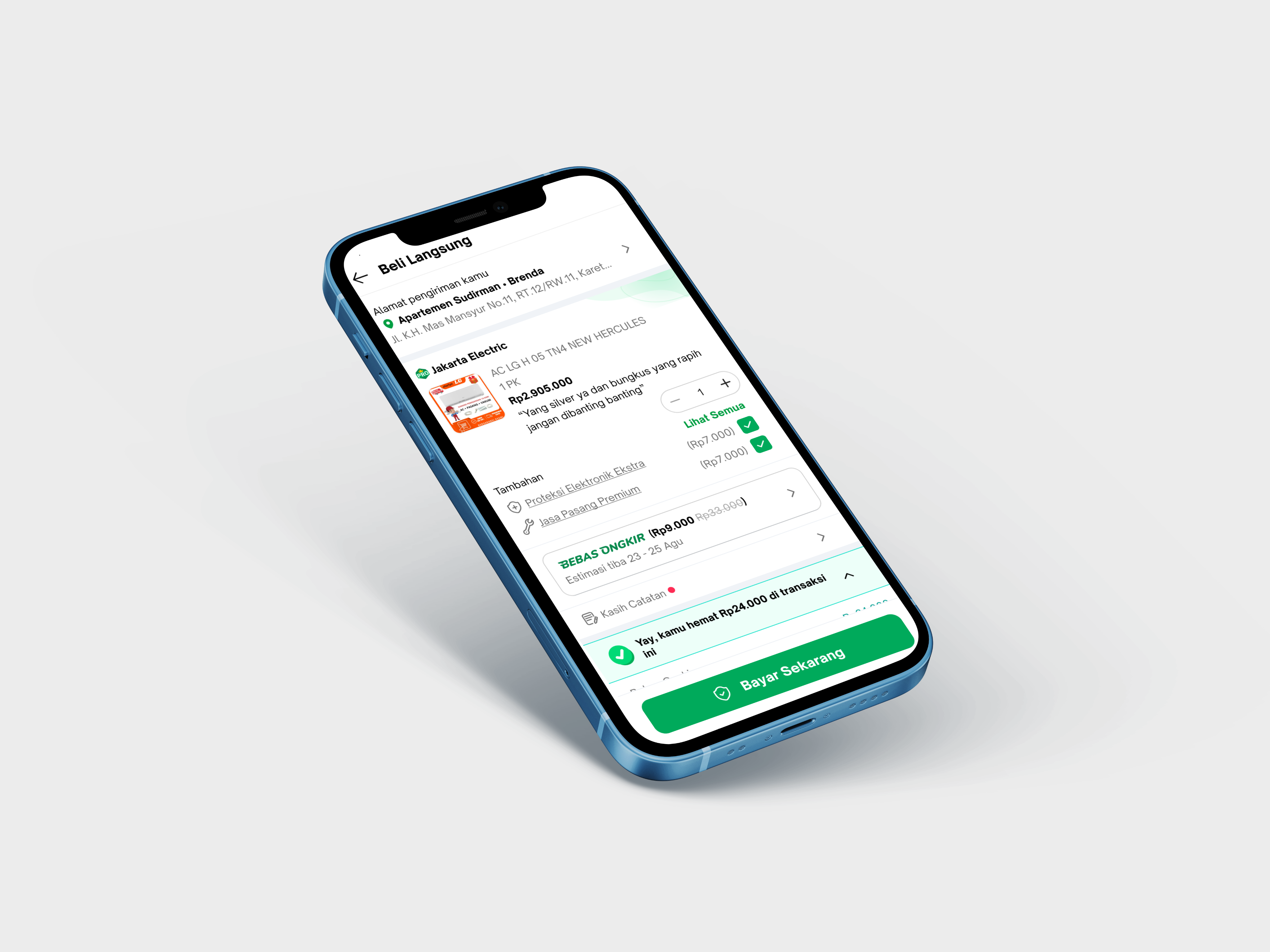
Improving Tokopedia Checkout Page
Context & responsibility
In Q1 2024, I was assigned to improve Tokopedia checkout page. I integrated payment selection into the checkout page to shorten the journey, and unify the One Click Checkout and Regular Checkout into one consistent structure, components, and information architecture.
Company
Tokopedia
Release date
Total of 5 phases (Q2 2024 - Q1 2025)
Role
Senior Product Designer
Why I won the Organization Spot Bonus Individual Award?
The project lacked a clear owner and required alignment across 3 big teams with 50+ core user scenarios. I took the lead in driving the initiative, enabling faster and more effective iterations based on user needs.
Existing Tokopedia purchase flow
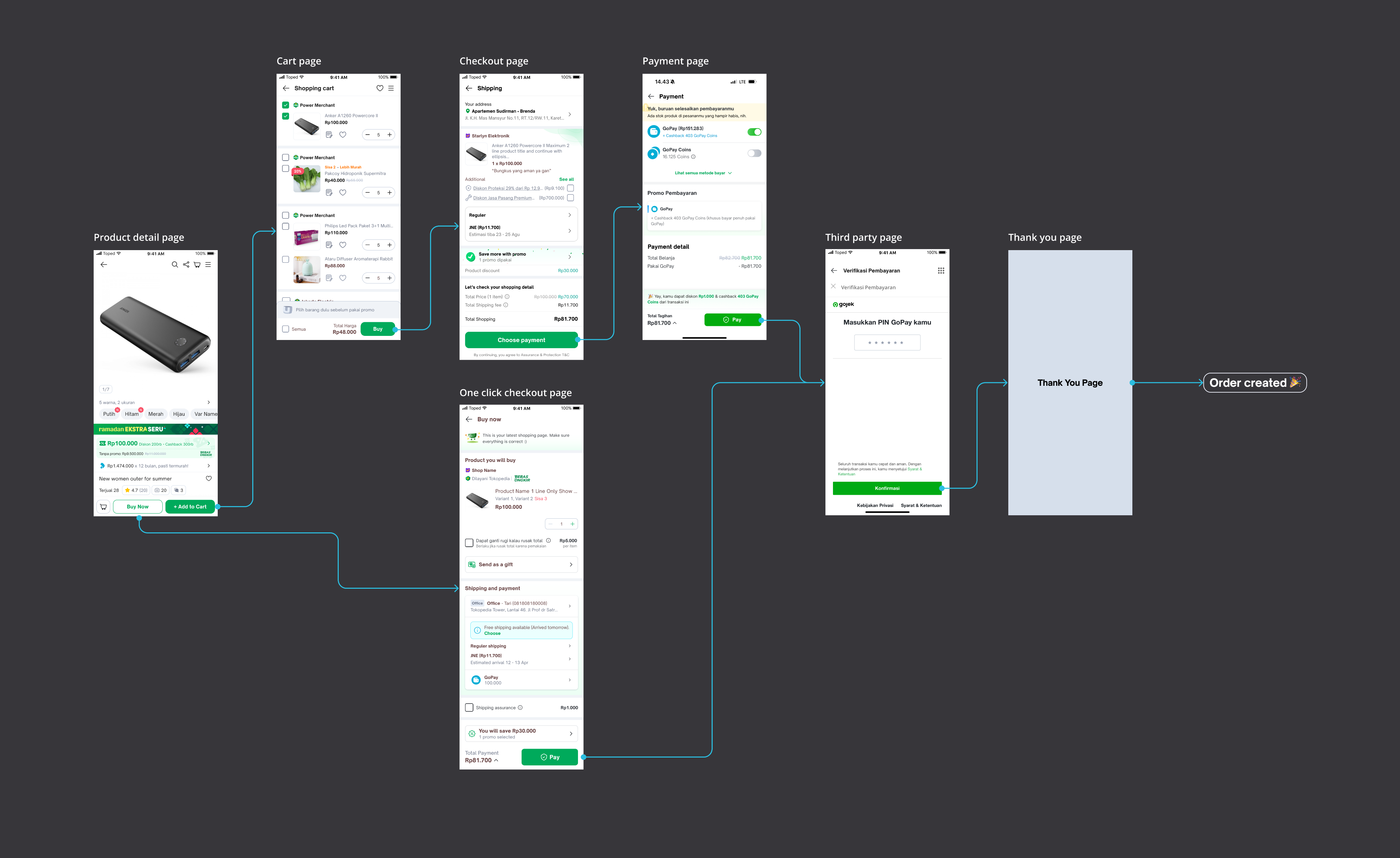
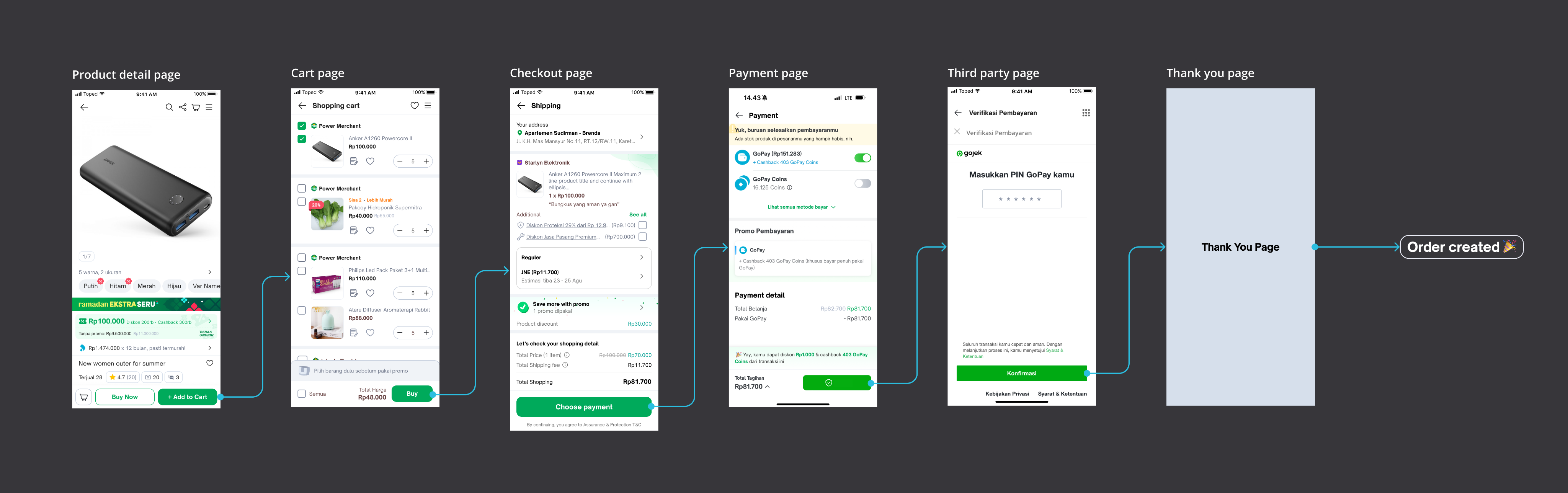
Users can enter the checkout flow in two ways: directly from the Product Detail Page through One Click Checkout, or from the Shopping Cart through Regular Checkout. Regardless of the entry point, they must navigate to a Payment page before placing an order. This flow created several opportunities to improve the purchase experience.
Identifying key problems
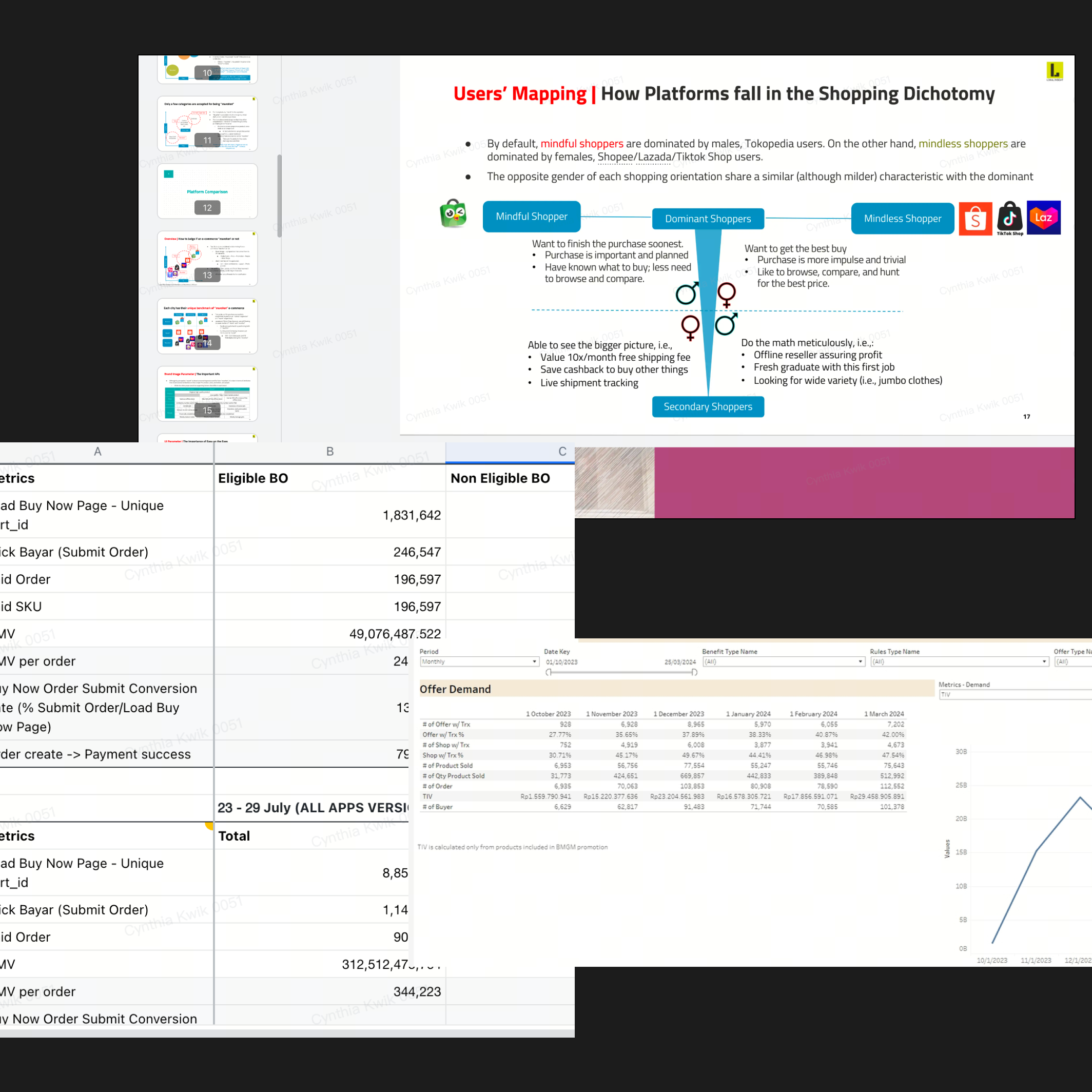
Analyze data and research
To get better understanding of how users interact with current design, finding pain point.
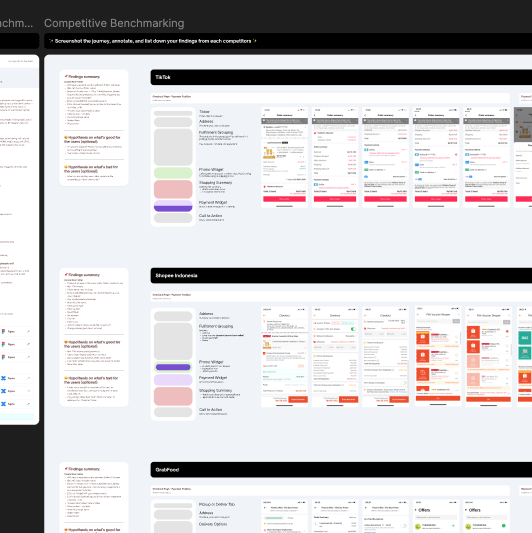
Competitive analysis
To discover feature gaps between Tokopedia and the competitors, by doing so we can find improvement opportunities.
Design audit
To get better understanding of own design structure. Finding inconsistency and usability issues.
3 main problems that I found
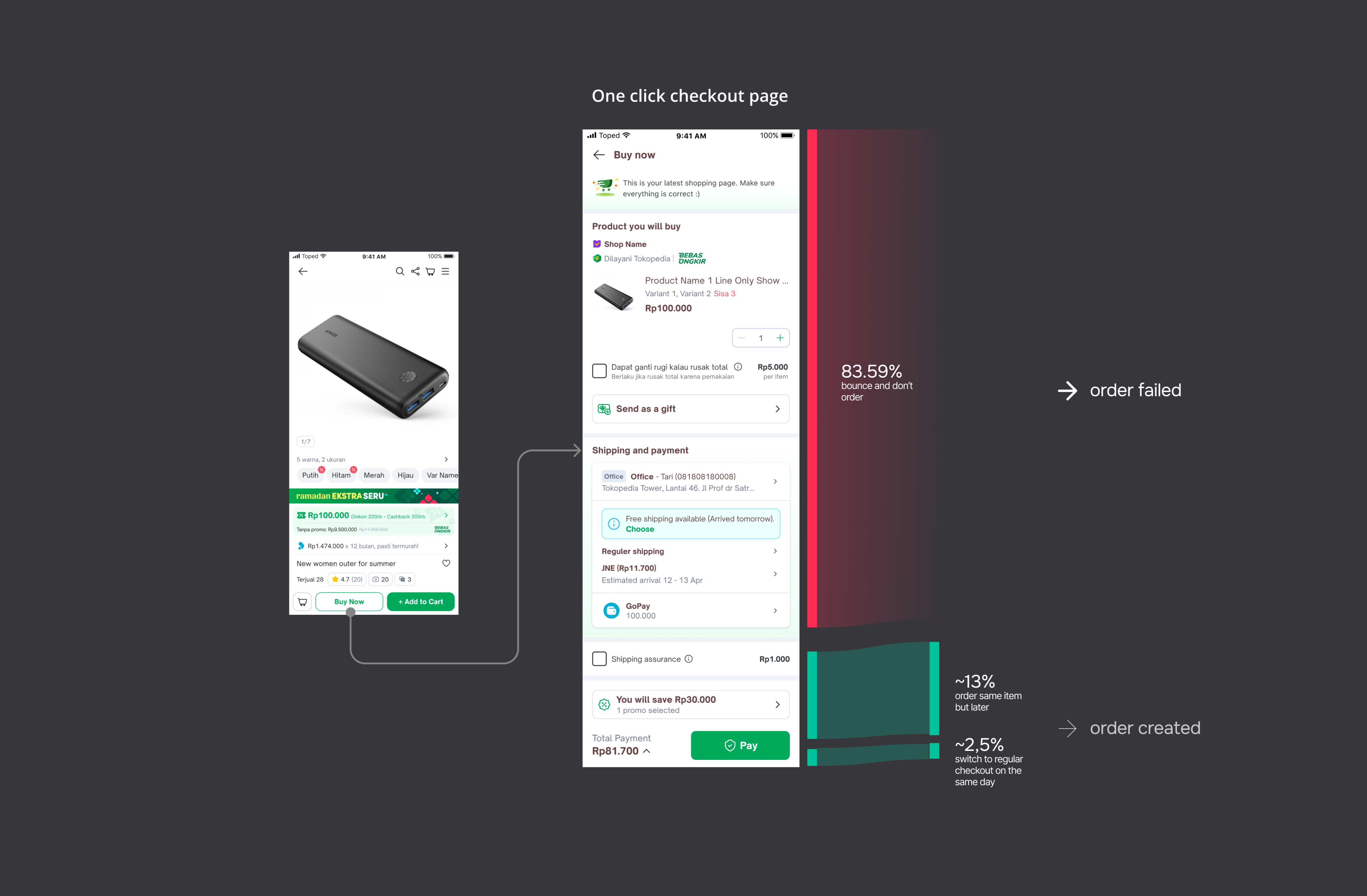
One click checkout page high exit rate
83.59% of buy now bounce and never order. ~11% order the same cart later, ~2.5% switch to regular checkout in same-day. But do we need this page in the first place? The answer is yes, it still shared 17.2% order of all order in Tokopedia. Hypothetically speaking, Tokopedia users ~83%
- High cost on maintaining two checkout pages
Separate checkout pages require duplicated design, engineering, QA, and maintenance efforts while serving the same purchasing goal. This limits scalability and slows future improvements.
- Too many steps to play an order
Current flow, user has to go through 4 pages, ≥ 7 clicks to place one order (Cart → SAF/Checkout → Payment list → Thank You).
These steps proven a pain point to the user through 3 data I got:
Competitive benchmarking
Most major competitors already implement payment-in-checkout for a seamless experience.
Observation
Users are bouncing back from the Payment page to the Checkout page, indicating the dedicated payment step created friction and lower the conversion rate.
Research
User said “I need to go go through multiple pages to proceed to payment, and I need to go back and forth between checkout and payment page to check everything”
How might we & objectives
To tackle those issues, 3 points need to be addressed
How might we
improve one click checkout user journey?
How might we
deliver a consistent and scalable checkout experience across different purchase journeys?
How might we
escalate user shopping journey while also minimizing order cancellations?

Objectives
Improve one click checkout experiences that encourages user to complete the purchase
Objectives
Create a consistent and scalable checkout experience across different purchase flows.
Objectives
Simplify the checkout process while ensuring users can confidently review and complete their orders.
How I solved it, starting by mapping out
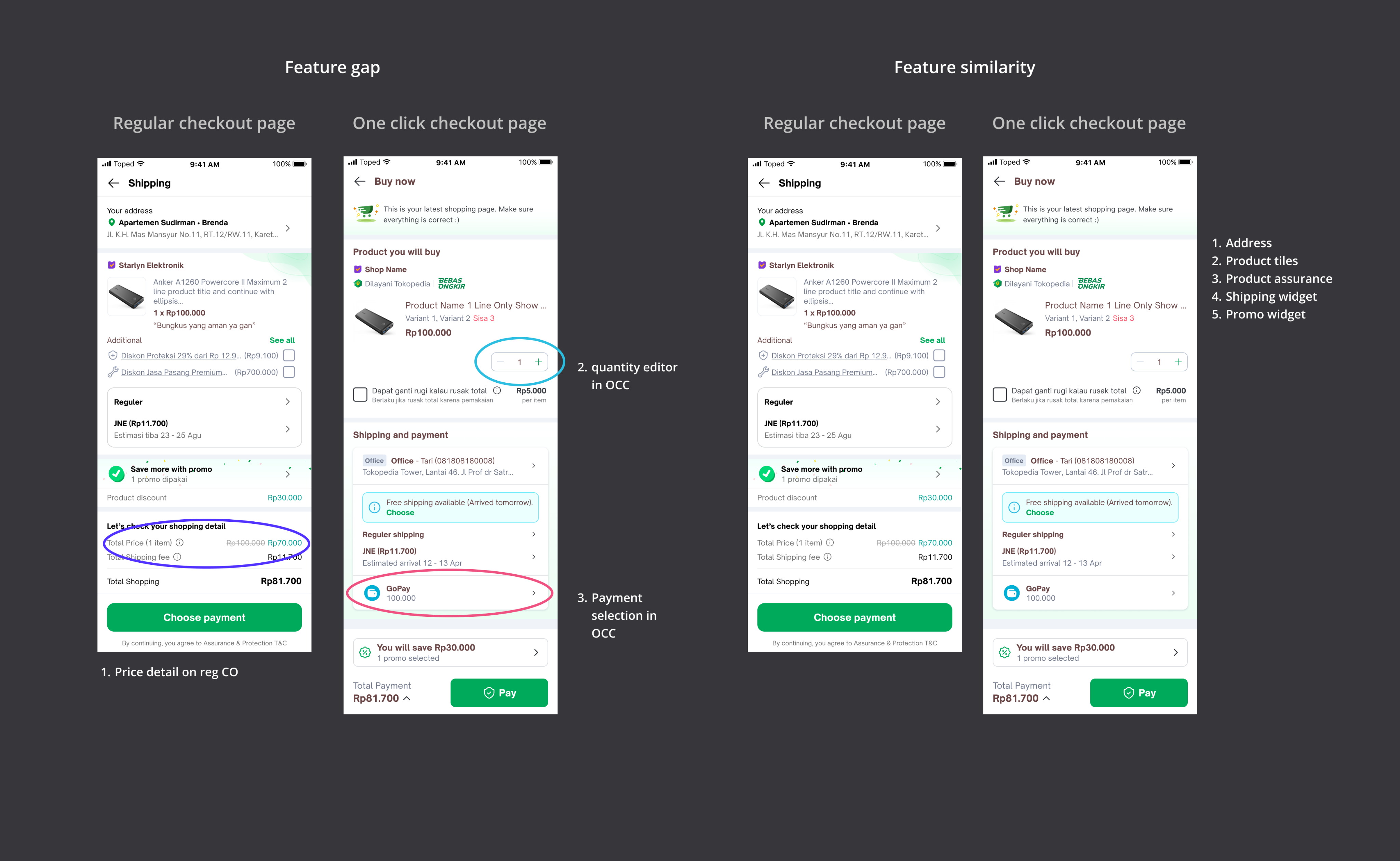
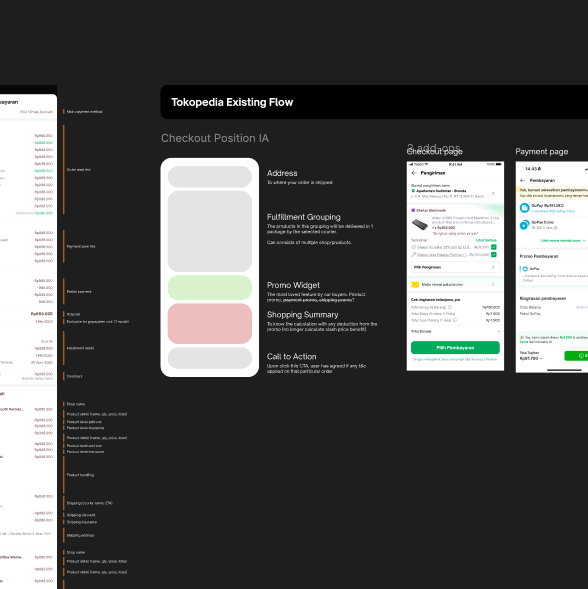
I mapped and clustered the information and features across One Click Checkout and Regular Checkout to identify gaps and understand the unique context of each journey. This helped determine whether either flow had distinct user needs that required different experiences. The analysis showed that One Click Checkout has two unique elements, a quantity editor and payment selection, while all other information and functionality are shared between both checkout flows.
Seeing most of the functions are shared between One Click and Regular Checkout page, my primary objective is to:
Create a scalable checkout design system that supports multiple purchase journeys through a consistent experience.
The main objective is to unify One Click Checkout and Regular Checkout into a single, scalable design system, while optimizing the experience to meet the unique context and user needs of each journey.
Get deep into the payment module
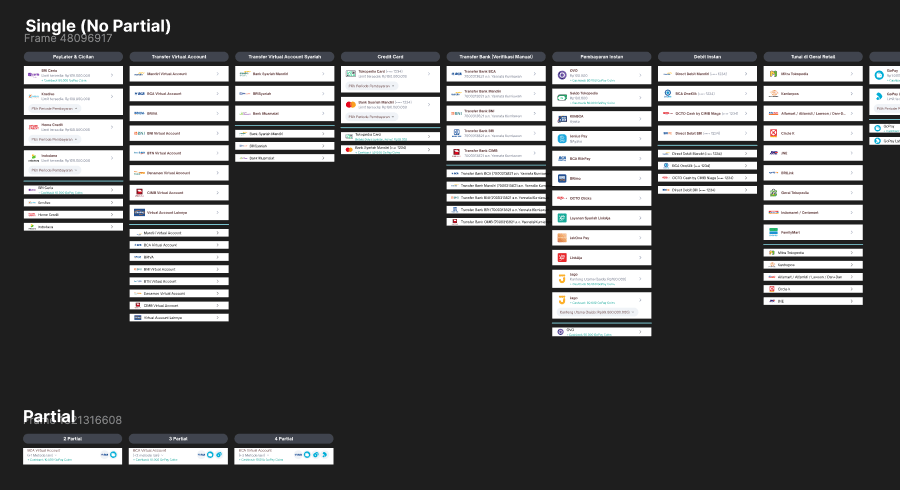
Studied and mapped out payment module
Because the Payment page was owned by a different team, I invested time in understanding the module by reviewing its end-to-end user flow, payment methods, promotional logic, and all existing use cases before proposing any design changes.
Lot of sketching & thinking
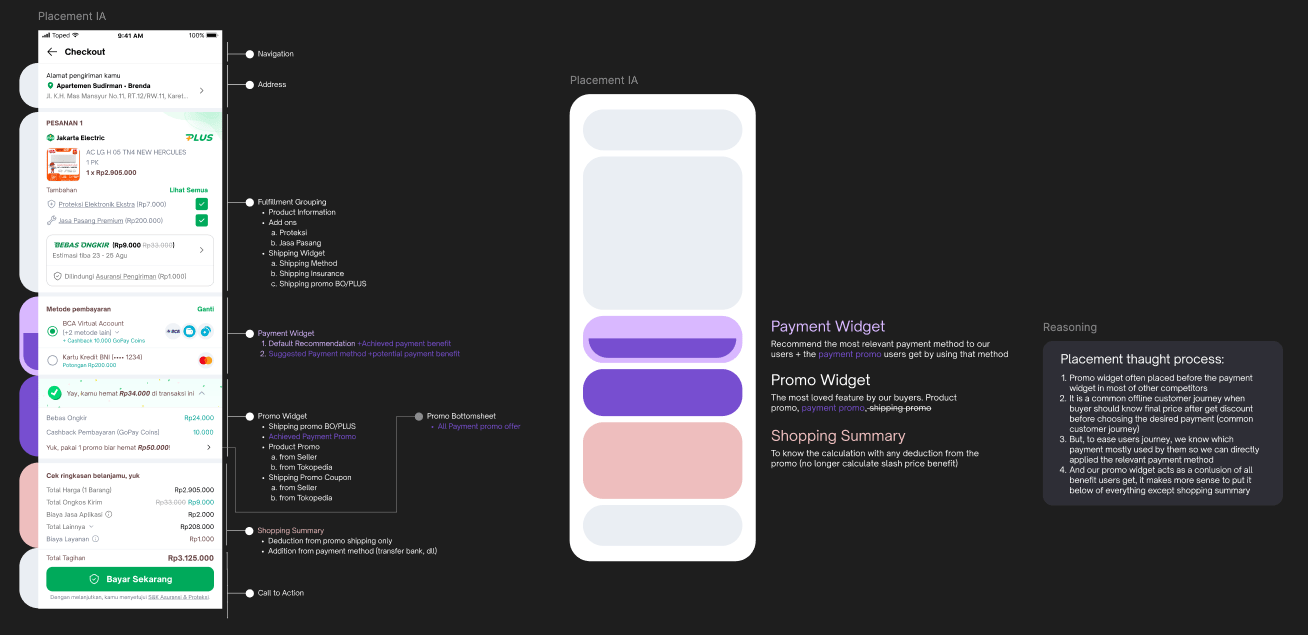
Clustered informations
Explored placement of all elements inside checkout page, including payment widget, promo widget, and shopping summary.
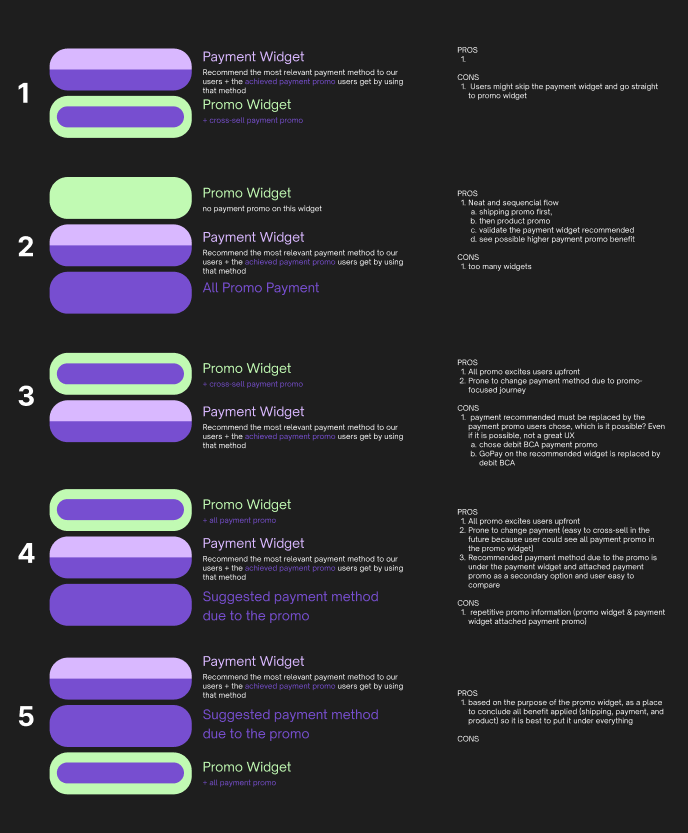
Mapped out relation of promotion
Explored the placement and relationship of payment promotion and payment recommendation. Collaborated closely with business stakeholders to ensure the design met bank compliance requirements.
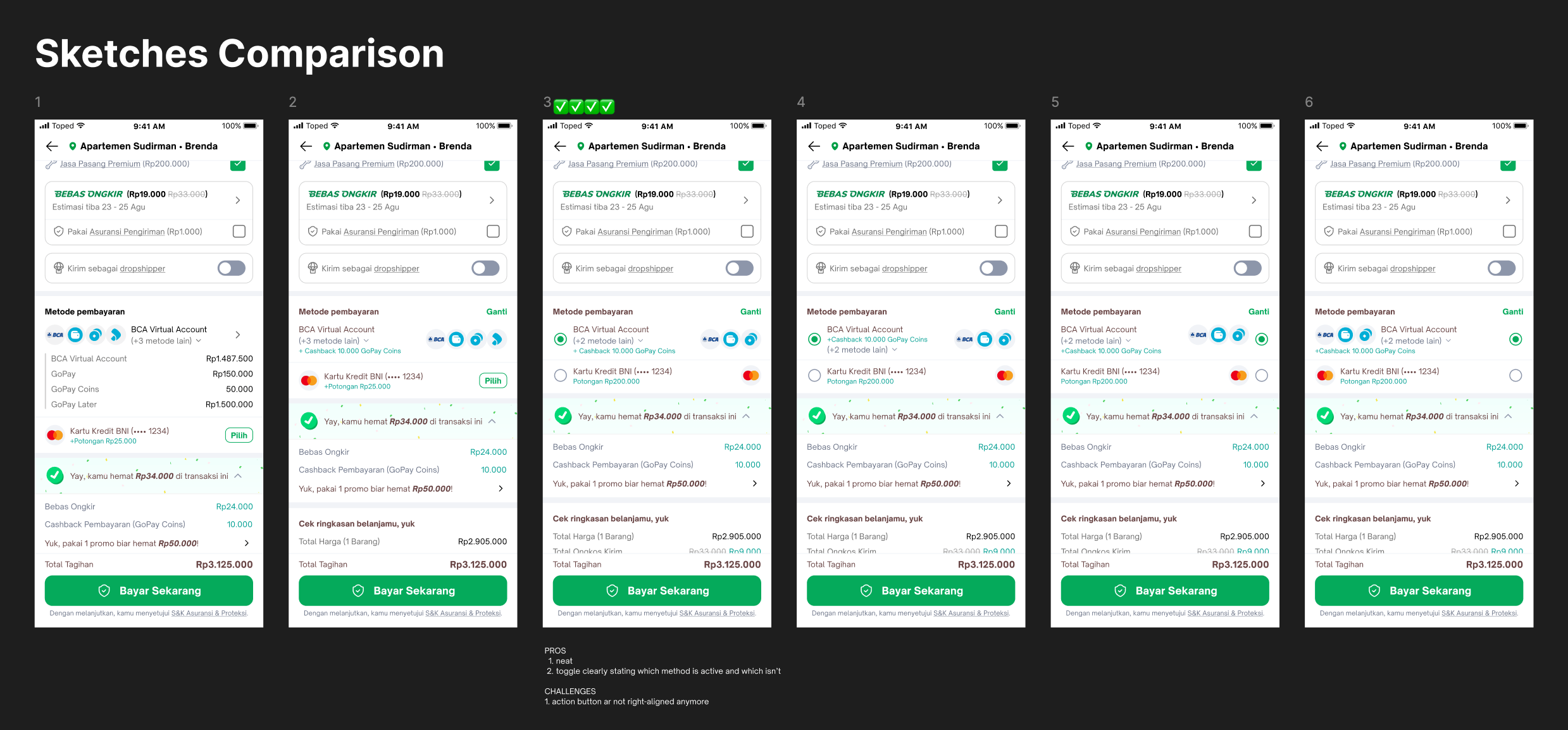
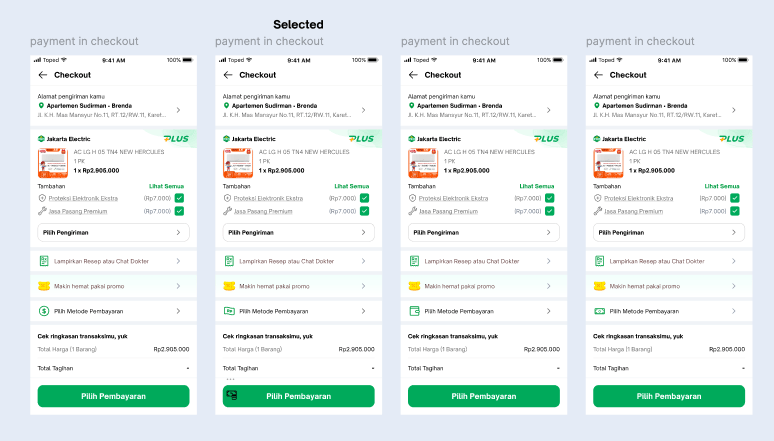
Did a lot of explorations
The relationships between payment, checkout, One Click Checkout, promotions, and other modules involved complex use cases. My explorations helped the team build a comprehensive understanding of the end-to-end journey.
Solution

- Scalable checkout design system
Old experience
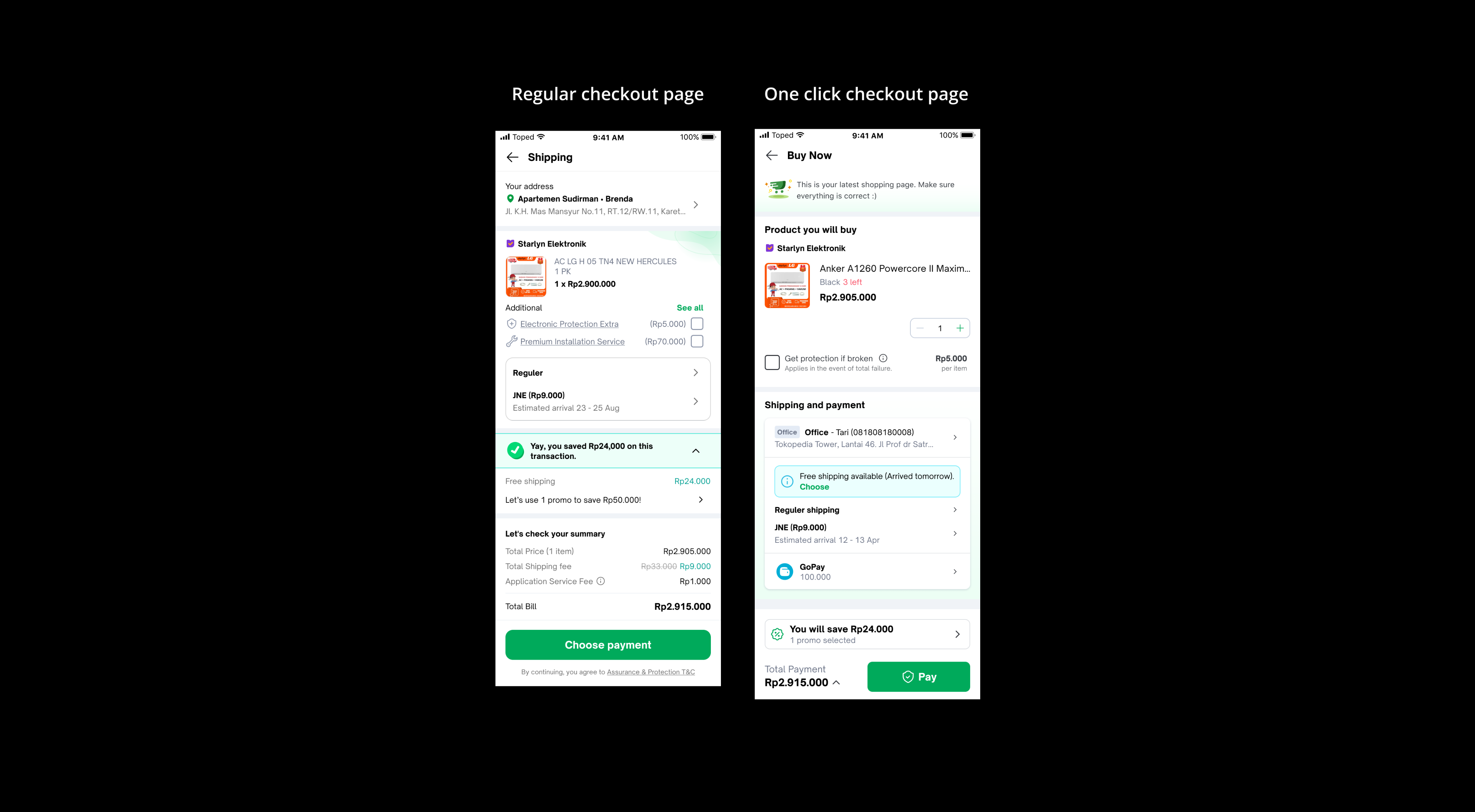
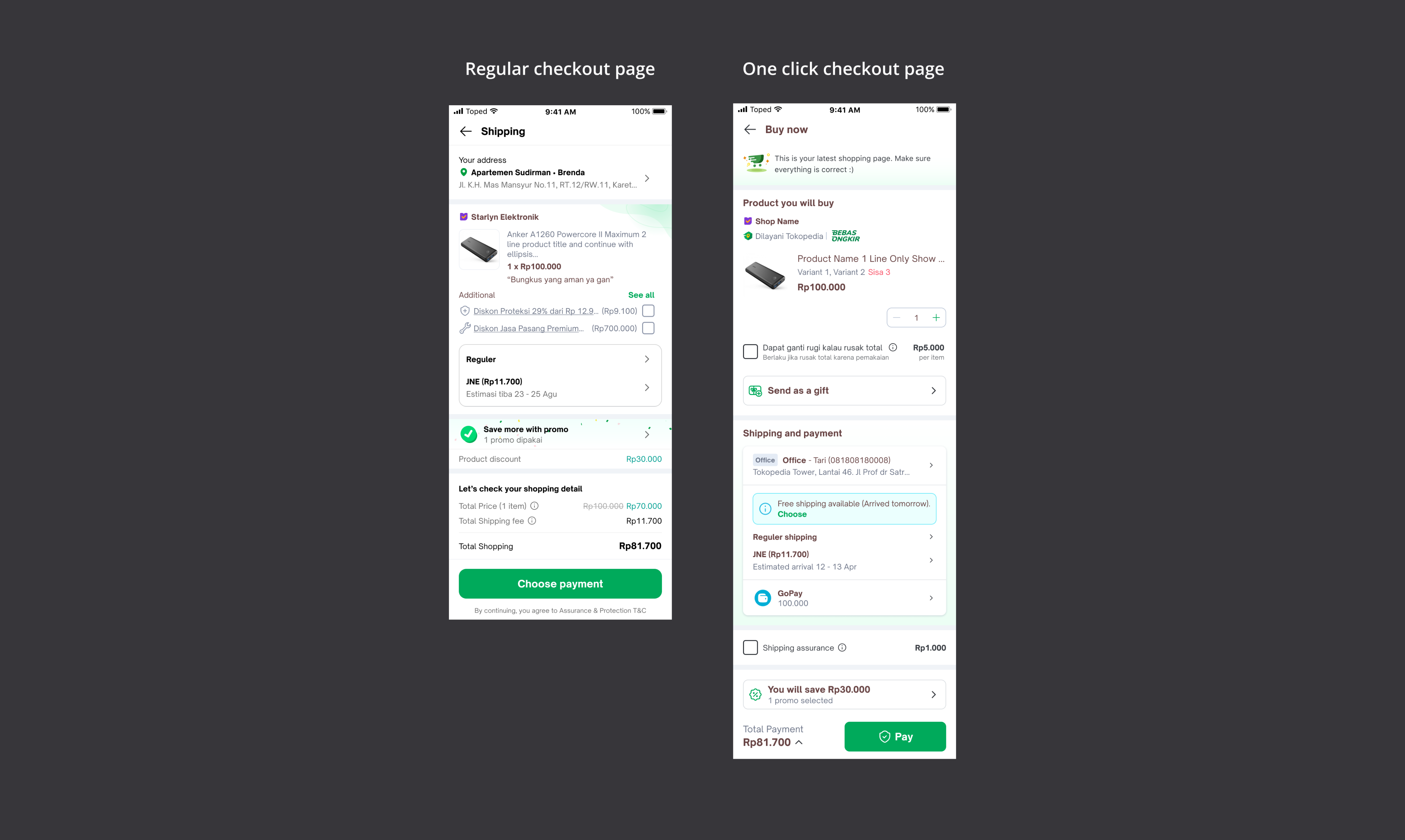
In this version, users will see two different checkout experiences with inconsistent UI, Regular Checkout, the checkout that comes from the Cart page and OCC (One-Click Checkout), the checkout that comes directly from the PDP. The biggest differences are the position of address and promo widget style.
Both flows had the same objective but different UI, which increased maintenance effort and confused users. Supported by data 83.59% of buy now users bounce and never order. 82,8% order of all order in Tokopedia are coming from regular checkout, indicating users are already familiar with the Regular Checkout experience. So encountering two checkout pages with different layouts and interactions creates unnecessary cognitive load and reduces user confidence.
And from a stakeholder perspective, maintaining two separate checkout pages resulted in high development and maintenance costs.
New experience
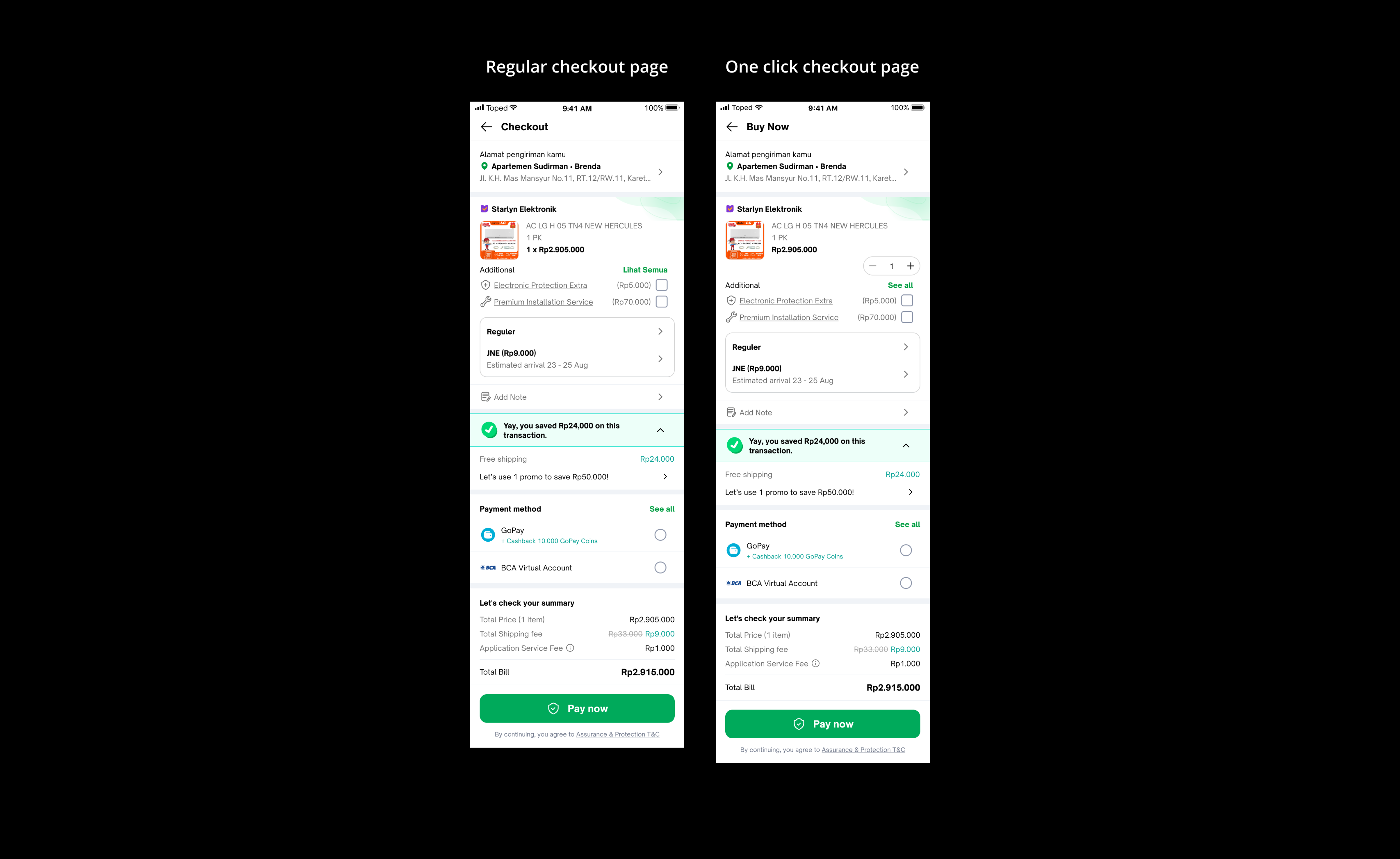
In this new solution, the One Click Checkout page and Checkout page is sharing the same design system. I unified the One Click Checkout and Regular Checkout into one consistent structure, components, and information architecture. Seeing unified two checkout pages with same layouts and interactions no longer creates unnecessary cognitive load and boost user confidence proven with consistent CVR uplifts. Meanings the regular checkout user is fine using the one click checkout page.
And by unifying this, the design, engineering, QA, and maintenance efforts were reduced 50% (2 pages to 1 page). This is easier for future iterations.
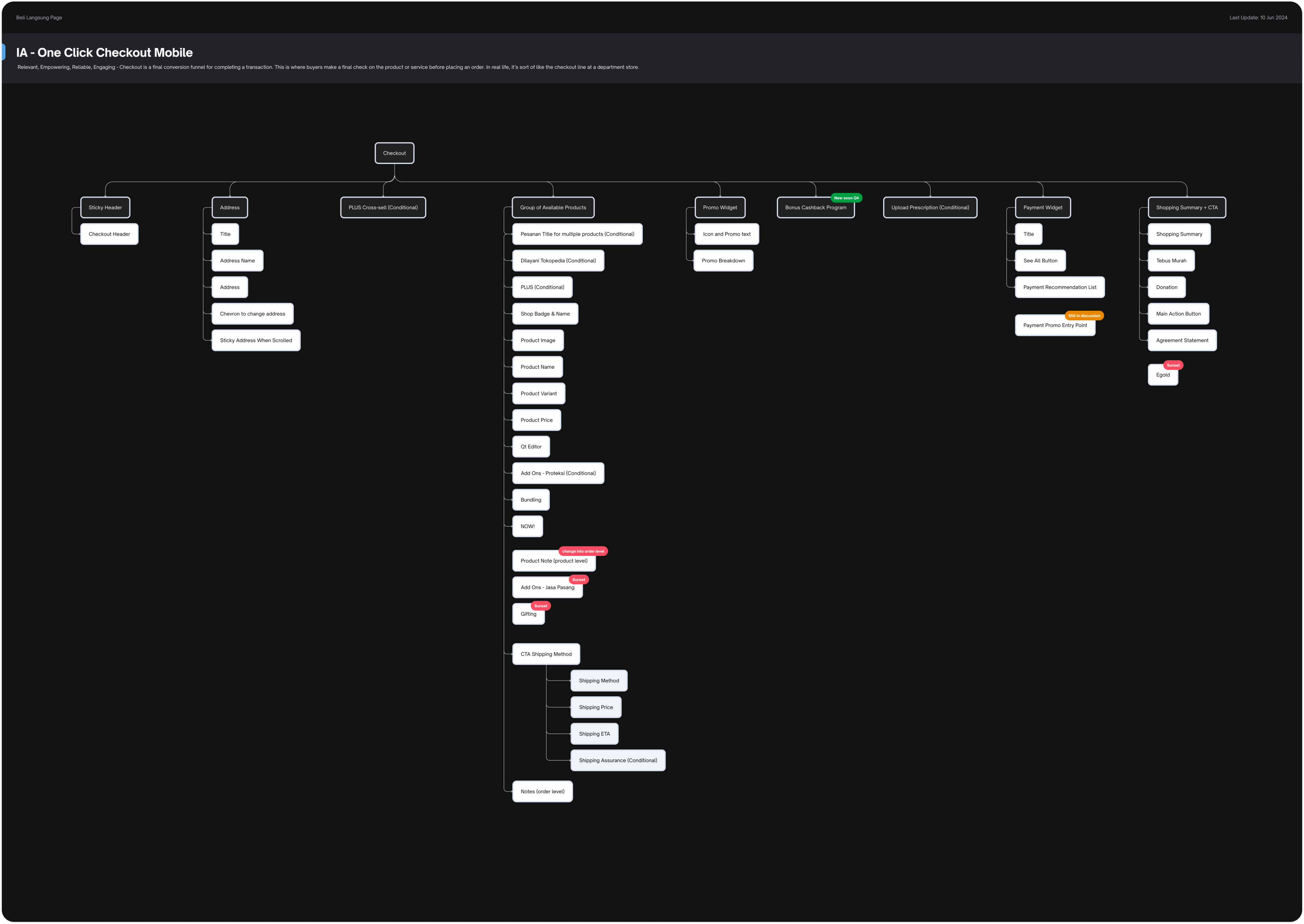
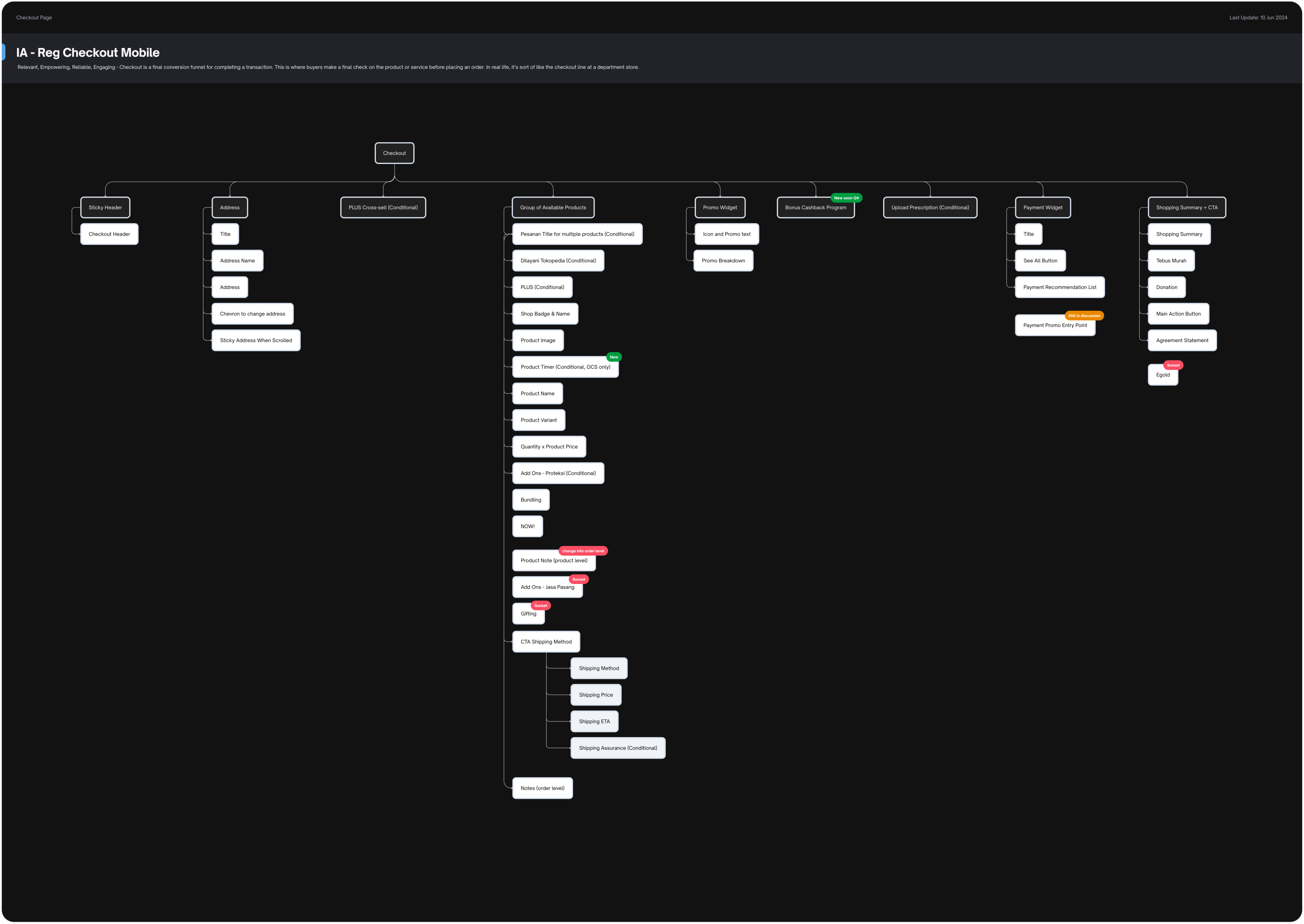
Mapped the information architecture of both checkout pages.
Consistent CVR uplifts
+5.16% in Q3 2024
+1.76% in Q4 2024
+0.42% in Q1 2025

- One Click Checkout contextual design
Old experience
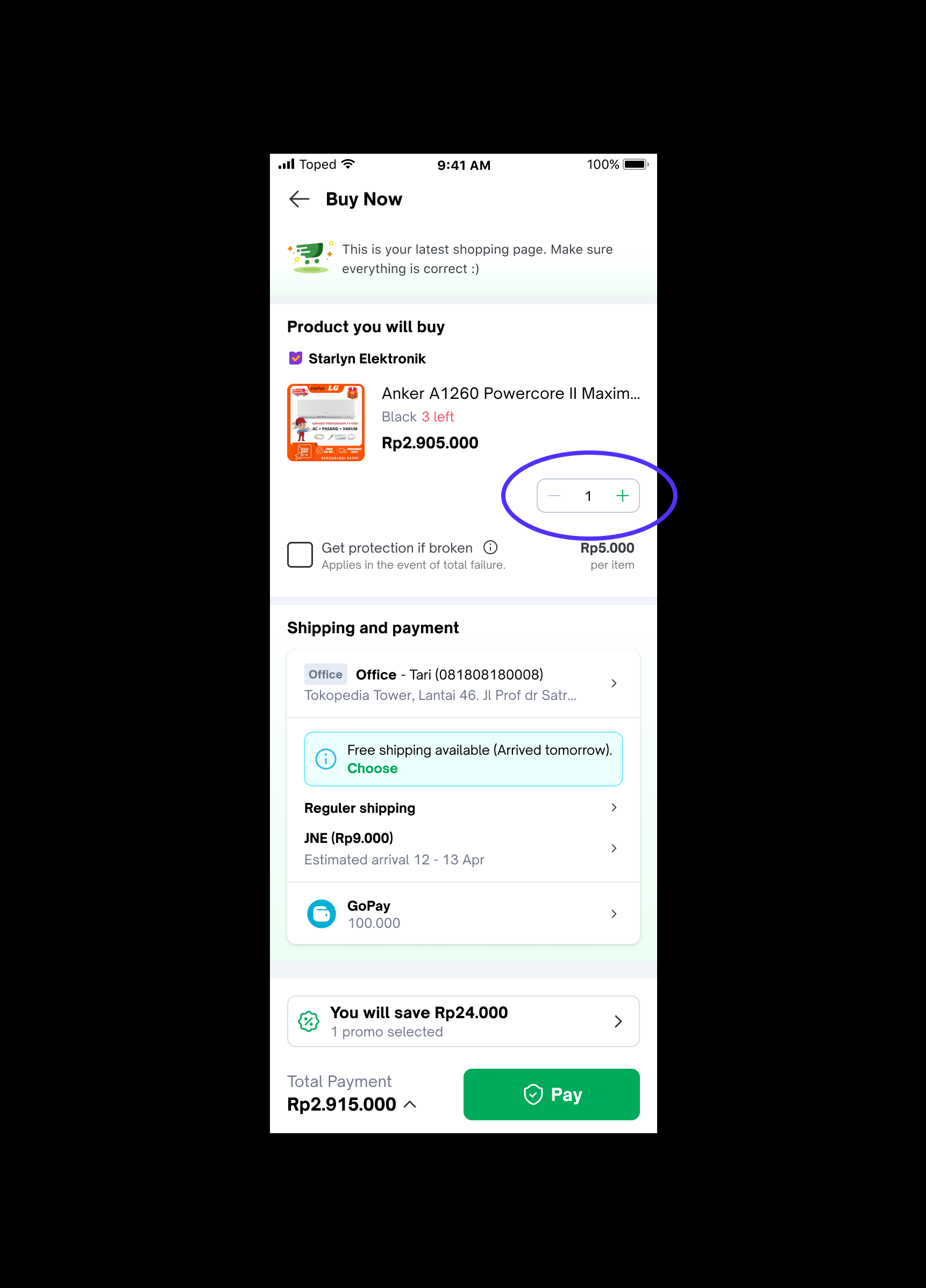
The key difference between One Click Checkout and Regular Checkout was the quantity editor. Since Buy Now users don't go through the shopping cart, they couldn't update the item quantity before checkout like Regular Checkout users could. This made quantity editing a unique requirement for the One Click Checkout journey.
New experience
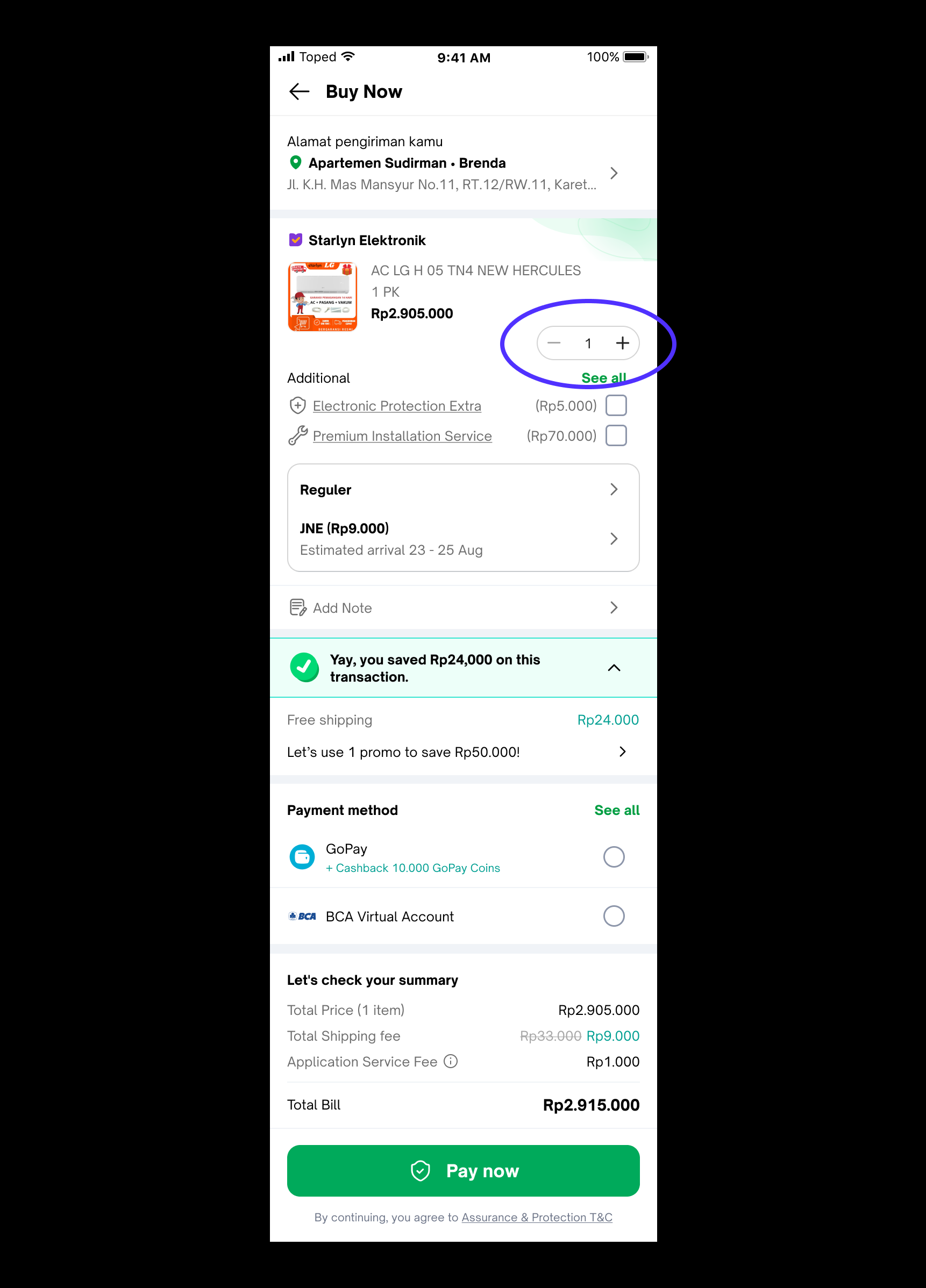
I integrate quantity editing into the unified checkout page design, ensuring the shared design system still supported the unique needs of One Click Checkout users. Adoption continued to grow after launch, validating that the feature was useful while maintaining a consistent and scalable checkout experience.
Adoption increased +5% (17.2% → 18.1%)
Order Created +3.69%
- Cut steps in Regular Checkout page
Old experience
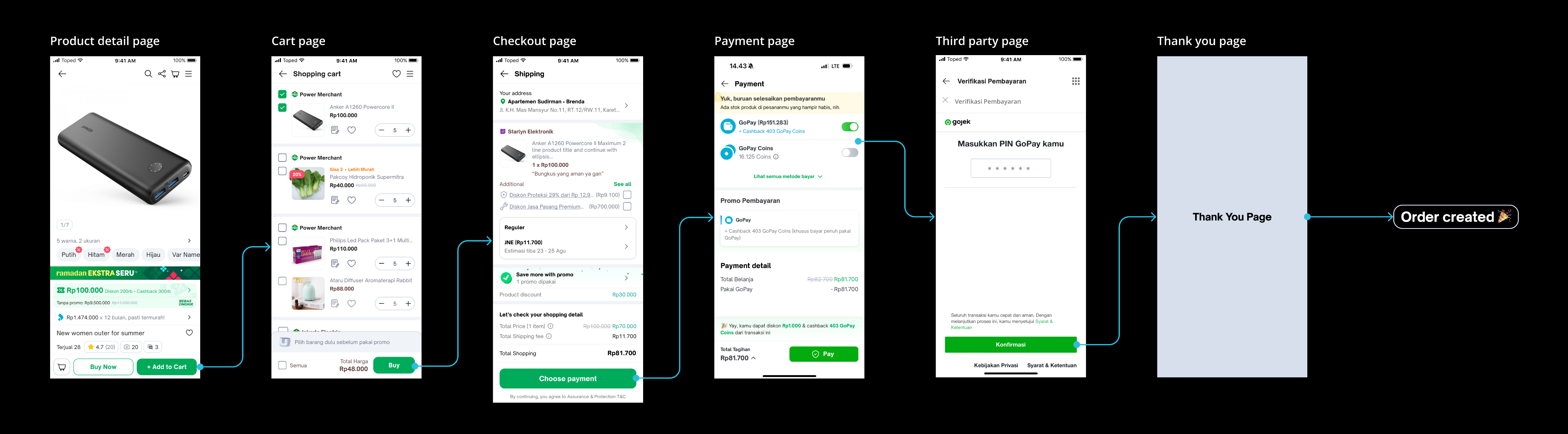
On current flow, users had to go through 4 pages and at least 7 clicks to complete a purchase (Cart → Checkout → Payment List → Thank You). Data showed that many users navigated back from the Payment page to the Checkout page, suggesting that the separate payment step added unnecessary friction to the journey.
New experience
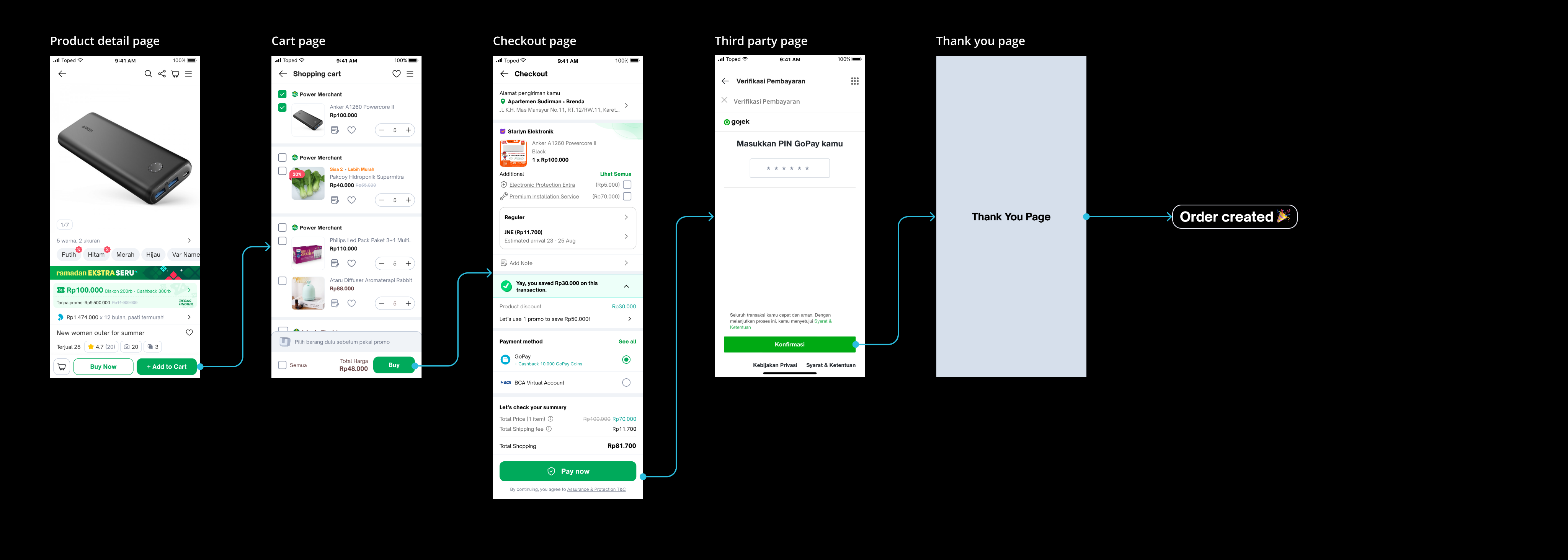
I integrated payment selection directly into the Checkout page, reducing the number of steps needed to complete a purchase. Before launch, I validated the concept through usability testing, where participants appreciated the faster flow and trusted the recommended payment method to match their preferences.
I also analyzed user behavior from One Click Checkout and found that only 11.13% of users changed their payment method, while ~89% completed their purchase using the pre-selected recommendation without opening the full payment list. This validated that the payment recommendation already met most users' needs.
After launch, the redesigned checkout delivered a +1.7% improvement in conversion rate (CVR), confirming that a shorter checkout flow reduced friction without compromising users' confidence in their payment choice.
Significantly improved:
- CVR Checkout → Order Create +1.7%
- CVR ATC → Order Create +3.4%
- New experience introduction in Regular Checkout
New experience
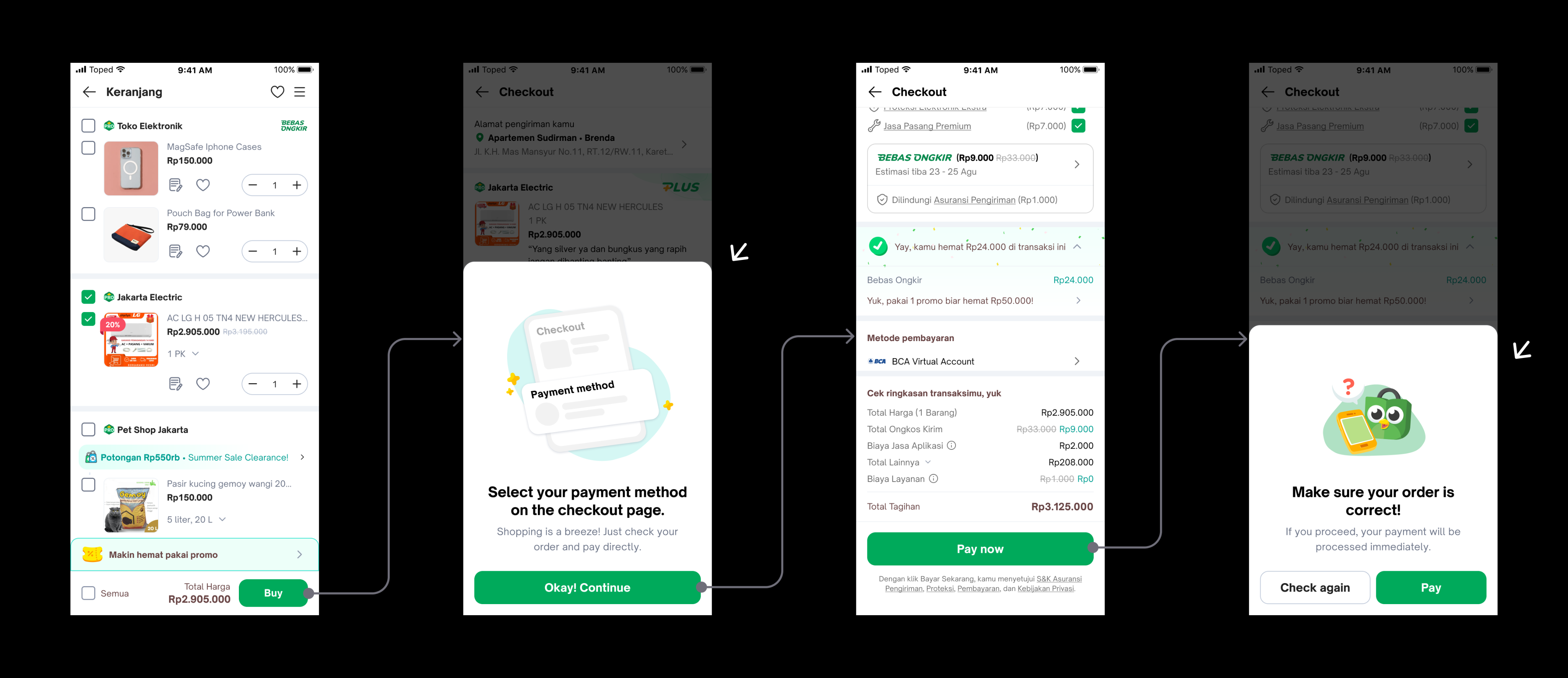
To help users adapt to the new payment flow, I introduced a one-time onboarding message when they first entered the redesigned checkout page. One of our biggest concerns was that integrating payment into checkout might increase order cancellations, as users would skip the familiar Payment page and its payment widget.
Cancellation rate remain stable
- Step up to uncertainty in the collaboration
Problems
The project lacked a clear owner and required alignment across three major teams, covering more than 50 core user scenarios. While the Checkout, Payment, and Promotion teams each had deep expertise in their own domains, there was no shared understanding of how these systems would work together in a unified checkout experience.
Solutions
I took the lead in connecting these pieces together, defining how payment should work within the checkout page, how payment promotions integrate with payment selection, and how they interact with product and shipping promotions. By aligning stakeholders around a shared user journey, I helped the team iterate faster and make design decisions based on user needs.
Faster iterations, reduced risk, and ensured the project on schedule
Winning the spot bonus individual award
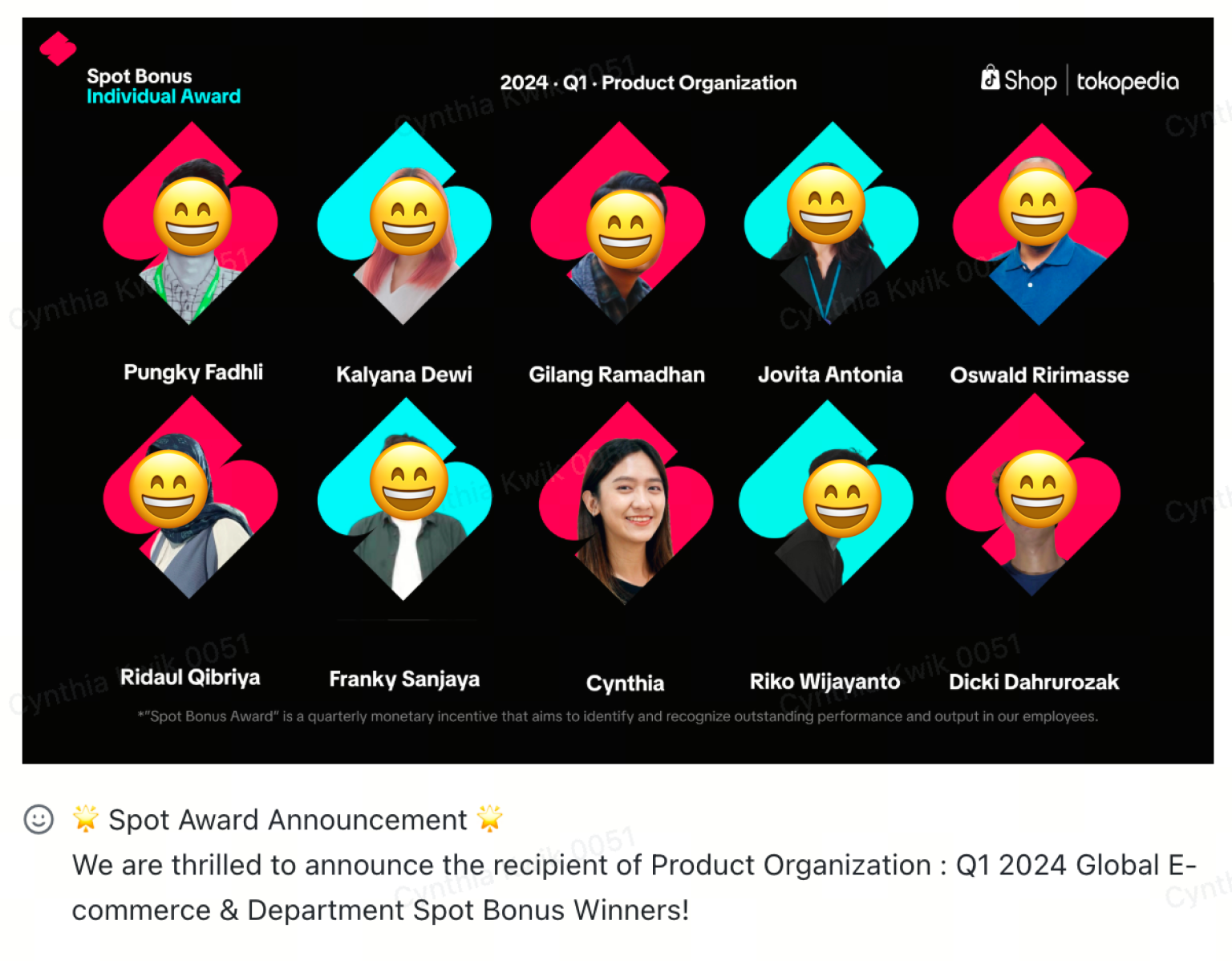
I has consistently demonstrated demonstrated strong ownership and high performance by driving cross-functional collaboration across the Checkout, Payment, and Promotion teams. Enabled faster iterations and aligned stakeholders around a unified user experience. I also led and influenced design decisions through clear logic reasoning and data-driven insights.
- Detailed output, think holistically
Mapped the end-to-end checkout journey, including secondary pages, to understand the relationships and interactions across the entire experience (Fig. 1). This exploration revealed that each payment method has unique behaviors, requirements, and contextual states that needed to be accommodated.
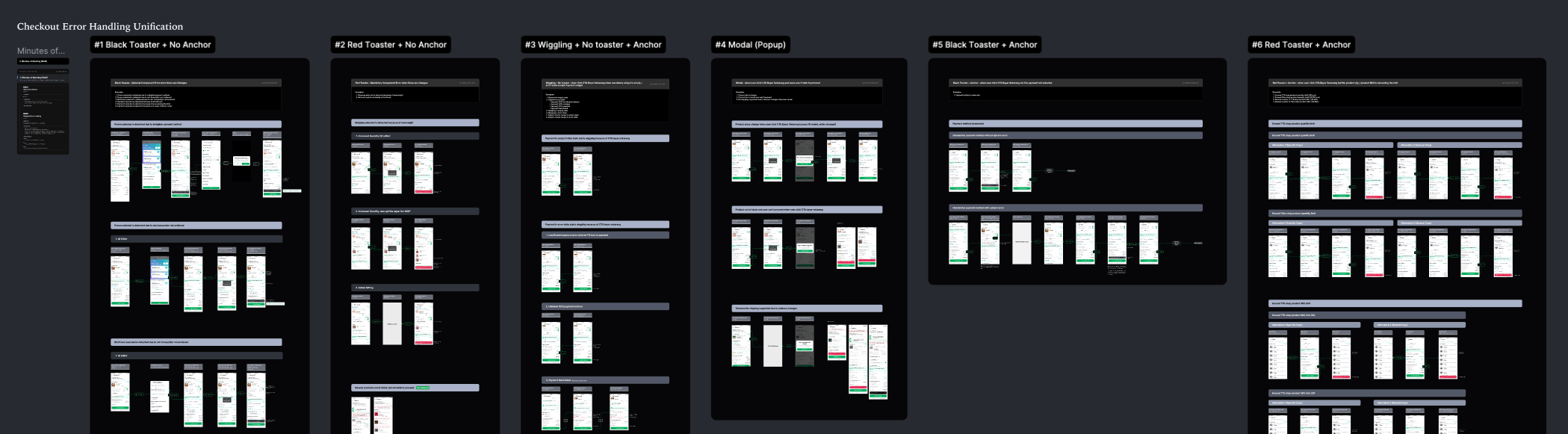
Although error handling was not originally within the project scope, the interactions between payment promotions, the payment widget, the logistics widget, and the checkout page introduced numerous error scenarios. To ensure a consistent user experience, I proactively identified, consolidated, and defined a unified error-handling framework for these cases (Fig. 2).

All result 🎉
The project shipped in five phases. It delivered consistent CVR uplifts across every phase without regressing overall GMV, far exceeding the original North Star target.
Phase 1 Q2 2024 - New One Click Checkout first launch
CVR One Click Checkout → Order created
+5.96%
GMV
+8.91%
Phase 2 Q3 2024 - New One Click Checkout + Cash On Delivery Enablement (COD is the #1 payment method used by OCC user)
CVR One Click Checkout → Order created
+6.17% significant
GMV
+15.69%
Paid Order with COD Buy Now
+8.4%
Order created → Payment Success
+0.97%
Phase 3 Q4 2024 - All payment method in One Click Checkout
CVR One Click Checkout → Order created
+3.69%
Phase 4 Q4 2024 - Shortening Regular Checkout Flow
CVR Checkout → Order created
+1.7% significant
CVR ATC → Order created
+3.4% significant
Phase 5 Q1 2025 - Multi payment method on payment widget
CVR order created → paid
+0.42%
One click checkout adoption gradually increased +5% (17.2% in April → 17.6% in May → 18.1% in June)

Other Projects

See Old Portfolio
→
CONTACT
(+62) 8179880051
cynthiaskwik@gmail.com
SOCIAL
Awarded Organization Spot Bonus Individual Award. Boosted CVR significantly.
Improving Tokopedia Checkout Page
Context & responsibility
In Q1 2024, I was assigned to improve Tokopedia checkout page. I integrated payment selection into the checkout page to shorten the journey, and unify the One Click Checkout and Regular Checkout into one consistent structure, components, and information architecture.
Company
Tokopedia
Release date
Total of 5 phases (Q2 2024 - Q1 2025)
Role
Senior Product Designer
Why I won the Organization Spot Bonus Individual Award?
The project lacked a clear owner and required alignment across 3 big teams with 50+ core user scenarios. I took the lead in driving the initiative, enabling faster and more effective iterations based on user needs.
Existing Tokopedia purchase flow
Users can enter the checkout flow in two ways: directly from the Product Detail Page through One Click Checkout, or from the Shopping Cart through Regular Checkout. Regardless of the entry point, they must navigate to a Payment page before placing an order. This flow created several opportunities to improve the purchase experience.
Identifying key problems
Analyze data and research
To get better understanding of how users interact with current design, finding pain point.
Competitive analysis
To discover feature gaps between Tokopedia and the competitors, by doing so we can find improvement opportunities.
Design audit
To get better understanding of own design structure. Finding inconsistency and usability issues.
3 main problems that I found
One click checkout page high exit rate
83.59% of buy now bounce and never order. ~11% order the same cart later, ~2.5% switch to regular checkout in same-day. But do we need this page in the first place? The answer is yes, it still shared 17.2% order of all order in Tokopedia. Hypothetically speaking, Tokopedia users ~83%
- High cost on maintaining two checkout pages
Separate checkout pages require duplicated design, engineering, QA, and maintenance efforts while serving the same purchasing goal. This limits scalability and slows future improvements.
- Too many steps to play an order
Current flow, user has to go through 4 pages, ≥ 7 clicks to place one order (Cart → SAF/Checkout → Payment list → Thank You).
These steps proven a pain point to the user through 3 data I got:
Competitive benchmarking
Most major competitors already implement payment-in-checkout for a seamless experience.
Observation
Users are bouncing back from the Payment page to the Checkout page, indicating the dedicated payment step created friction and lower the conversion rate.
Research
User said “I need to go go through multiple pages to proceed to payment, and I need to go back and forth between checkout and payment page to check everything”
How might we & objectives
To tackle those issues, 3 points need to be addressed
How might we
improve one click checkout user journey?
How might we
deliver a consistent and scalable checkout experience across different purchase journeys?
How might we
escalate user shopping journey while also minimizing order cancellations?

Objectives
Improve one click checkout experiences that encourages user to complete the purchase
Objectives
Create a consistent and scalable checkout experience across different purchase flows.
Objectives
Simplify the checkout process while ensuring users can confidently review and complete their orders.
How I solved it, starting by mapping out
I mapped and clustered the information and features across One Click Checkout and Regular Checkout to identify gaps and understand the unique context of each journey. This helped determine whether either flow had distinct user needs that required different experiences. The analysis showed that One Click Checkout has two unique elements, a quantity editor and payment selection, while all other information and functionality are shared between both checkout flows.
Seeing most of the functions are shared between One Click and Regular Checkout page, my primary objective is to:
Create a scalable checkout design system that supports multiple purchase journeys through a consistent experience.
The main objective is to unify One Click Checkout and Regular Checkout into a single, scalable design system, while optimizing the experience to meet the unique context and user needs of each journey.
Get deep into the payment module
Studied and mapped out payment module
Because the Payment page was owned by a different team, I invested time in understanding the module by reviewing its end-to-end user flow, payment methods, promotional logic, and all existing use cases before proposing any design changes.
Lot of sketching & thinking
Clustered informations
Explored placement of all elements inside checkout page, including payment widget, promo widget, and shopping summary.
Mapped out relation of promotion
Explored the placement and relationship of payment promotion and payment recommendation. Collaborated closely with business stakeholders to ensure the design met bank compliance requirements.
Did a lot of explorations
The relationships between payment, checkout, One Click Checkout, promotions, and other modules involved complex use cases. My explorations helped the team build a comprehensive understanding of the end-to-end journey.
Solution

- Scalable checkout design system
Old experience
In this version, users will see two different checkout experiences with inconsistent UI, Regular Checkout, the checkout that comes from the Cart page and OCC (One-Click Checkout), the checkout that comes directly from the PDP. The biggest differences are the position of address and promo widget style.
Both flows had the same objective but different UI, which increased maintenance effort and confused users. Supported by data 83.59% of buy now users bounce and never order. 82,8% order of all order in Tokopedia are coming from regular checkout, indicating users are already familiar with the Regular Checkout experience. So encountering two checkout pages with different layouts and interactions creates unnecessary cognitive load and reduces user confidence.
And from a stakeholder perspective, maintaining two separate checkout pages resulted in high development and maintenance costs.
New experience
In this new solution, the One Click Checkout page and Checkout page is sharing the same design system. I unified the One Click Checkout and Regular Checkout into one consistent structure, components, and information architecture. Seeing unified two checkout pages with same layouts and interactions no longer creates unnecessary cognitive load and boost user confidence proven with consistent CVR uplifts. Meanings the regular checkout user is fine using the one click checkout page.
And by unifying this, the design, engineering, QA, and maintenance efforts were reduced 50% (2 pages to 1 page). This is easier for future iterations.
Mapped the information architecture of both checkout pages.
Reducing cost by 50% (2 pages → 1 page)
Consistent CVR uplifts
+5.16% in Q3 2024
+1.76% in Q4 2024
+0.42% in Q1 2025

- One Click Checkout contextual design
Old experience
The key difference between One Click Checkout and Regular Checkout was the quantity editor. Since Buy Now users don't go through the shopping cart, they couldn't update the item quantity before checkout like Regular Checkout users could. This made quantity editing a unique requirement for the One Click Checkout journey.
New experience
I integrate quantity editing into the unified checkout page design, ensuring the shared design system still supported the unique needs of One Click Checkout users. Adoption continued to grow after launch, validating that the feature was useful while maintaining a consistent and scalable checkout experience.
Adoption increased +5% (17.2% → 18.1%)
Order Created +3.69%
- Cut steps in Regular Checkout page
Old experience
On current flow, users had to go through 4 pages and at least 7 clicks to complete a purchase (Cart → Checkout → Payment List → Thank You). Data showed that many users navigated back from the Payment page to the Checkout page, suggesting that the separate payment step added unnecessary friction to the journey.
New experience
I integrated payment selection directly into the Checkout page, reducing the number of steps needed to complete a purchase. Before launch, I validated the concept through usability testing, where participants appreciated the faster flow and trusted the recommended payment method to match their preferences.
I also analyzed user behavior from One Click Checkout and found that only 11.13% of users changed their payment method, while ~89% completed their purchase using the pre-selected recommendation without opening the full payment list. This validated that the payment recommendation already met most users' needs.
After launch, the redesigned checkout delivered a +1.7% improvement in conversion rate (CVR), confirming that a shorter checkout flow reduced friction without compromising users' confidence in their payment choice.
Significantly improved:
- CVR Checkout → Order Create +1.7%
- CVR ATC → Order Create +3.4%
- New experience introduction in Regular Checkout
New experience
To help users adapt to the new payment flow, I introduced a one-time onboarding message when they first entered the redesigned checkout page. One of our biggest concerns was that integrating payment into checkout might increase order cancellations, as users would skip the familiar Payment page and its payment widget.
Cancellation rate remain stable
- Step up to uncertainty in the collaboration
Problems
The project lacked a clear owner and required alignment across three major teams, covering more than 50 core user scenarios. While the Checkout, Payment, and Promotion teams each had deep expertise in their own domains, there was no shared understanding of how these systems would work together in a unified checkout experience.
Solutions
I took the lead in connecting these pieces together, defining how payment should work within the checkout page, how payment promotions integrate with payment selection, and how they interact with product and shipping promotions. By aligning stakeholders around a shared user journey, I helped the team iterate faster and make design decisions based on user needs.
Faster iterations, reduced risk, and ensured the project on schedule
Winning the spot bonus individual award
I has consistently demonstrated demonstrated strong ownership and high performance by driving cross-functional collaboration across the Checkout, Payment, and Promotion teams. Enabled faster iterations and aligned stakeholders around a unified user experience. I also led and influenced design decisions through clear logic reasoning and data-driven insights.
- Detailed output, think holistically
Mapped the end-to-end checkout journey, including secondary pages, to understand the relationships and interactions across the entire experience (Fig. 1). This exploration revealed that each payment method has unique behaviors, requirements, and contextual states that needed to be accommodated.
Although error handling was not originally within the project scope, the interactions between payment promotions, the payment widget, the logistics widget, and the checkout page introduced numerous error scenarios. To ensure a consistent user experience, I proactively identified, consolidated, and defined a unified error-handling framework for these cases (Fig. 2).
All result 🎉
The project shipped in five phases. It delivered consistent CVR uplifts across every phase without regressing overall GMV, far exceeding the original North Star target.
Phase 1 Q2 2024 - New One Click Checkout first launch
CVR One Click Checkout → Order created
+5.96%
GMV
+8.91%
Phase 2 Q3 2024 - New One Click Checkout + Cash On Delivery Enablement (COD is the #1 payment method used by OCC user)
CVR One Click Checkout → Order created
+6.17% significant
GMV
+15.69%
Paid Order with COD Buy Now
+8.4%
Order created → Payment Success
+0.97%
Phase 3 Q4 2024 - All payment method in One Click Checkout
CVR One Click Checkout → Order created
+3.69%
Phase 4 Q4 2024 - Shortening Regular Checkout Flow
CVR Checkout → Order created
+1.7% significant
CVR ATC → Order created
+3.4% significant
Phase 5 Q1 2025 - Multi payment method on payment widget
CVR order created → paid
+0.42%
One click checkout adoption gradually increased +5% (17.2% in April → 17.6% in May → 18.1% in June)

Other Projects
See Old Portfolio
→
CONTACT
(+62) 8179880051
cynthiaskwik@gmail.com
SOCIAL
Awarded Organization Spot Bonus Individual Award. Boosted CVR significantly.
Improving Tokopedia Checkout Page
Context & responsibility
In Q1 2024, I was assigned to improve Tokopedia checkout page. I integrated payment selection into the checkout page to shorten the journey, and unify the One Click Checkout and Regular Checkout into one consistent structure, components, and information architecture.
Company
Tokopedia
Release date
Total of 5 phases (Q2 2024 - Q1 2025)
Role
Senior Product Designer
Why I won the Organization Spot Bonus Individual Award?
The project lacked a clear owner and required alignment across 3 big teams with 50+ core user scenarios. I took the lead in driving the initiative, enabling faster and more effective iterations based on user needs.
Existing Tokopedia purchase flow
Users can enter the checkout flow in two ways: directly from the Product Detail Page through One Click Checkout, or from the Shopping Cart through Regular Checkout. Regardless of the entry point, they must navigate to a Payment page before placing an order. This flow created several opportunities to improve the purchase experience.
Identifying key problems
Analyze data and research
To get better understanding of how users interact with current design, finding pain point.
Competitive analysis
To discover feature gaps between Tokopedia and the competitors, by doing so we can find improvement opportunities.
Design audit
To get better understanding of own design structure. Finding inconsistency and usability issues.
3 main problems that I found
- One click checkout page has high exit rate
83.59% of buy now bounce and never order, ~11% order the same cart later, and ~2.5% switch to regular checkout in same-day. But do we need this page in the first place? The answer is yes, it still shared 17.2% order of all order in Tokopedia.
- High cost on maintaining two checkout pages
Separate checkout pages require duplicated design, engineering, QA, and maintenance efforts while serving the same purchasing goal. This limits scalability and slows future improvements.
- Too many steps to place an order
On current flow, user has to go through 4 pages and at least 7 clicks to place one order (Cart → Checkout → Payment list → Thank You).
These steps proven a pain point to the user through 3 data I got:
Competitive benchmarking
Most major competitors already implement payment-in-checkout for a seamless experience.
Observation
Users are bouncing back from the Payment page to the Checkout page, indicating the dedicated payment step created friction and lower the conversion rate.
Research
User said “I need to go go through multiple pages to proceed to payment, and I need to go back and forth between checkout and payment page to check everything”
How might we & objectives
To tackle those issues, 3 points need to be addressed
How might we
improve one click checkout user journey?
How might we
deliver a consistent and scalable checkout experience across different purchase journeys?
How might we
escalate user shopping journey while also minimizing order cancellations?

Objectives
Improve one click checkout experiences that encourages user to complete the purchase
Objectives
Create a consistent and scalable checkout experience across different purchase flows.
Objectives
Simplify the checkout process while ensuring users can confidently review and complete their orders.
How I solved it, starting by mapping out
I mapped and clustered the information and features across One Click Checkout and Regular Checkout to identify gaps and understand the unique context of each journey. This helped determine whether either flow had distinct user needs that required different experiences. The analysis showed that One Click Checkout has two unique elements, a quantity editor and payment selection, while all other information and functionality are shared between both checkout flows.
Seeing most of the functions are shared between One Click and Regular Checkout page, my primary objective is to:
Create a scalable checkout design system that supports multiple purchase journeys through a consistent experience.
The main objective is to unify One Click Checkout and Regular Checkout into a single, scalable design system, while optimizing the experience to meet the unique context and user needs of each journey.
Get deep into the payment module
Studied and mapped out payment module
Because the Payment page was owned by a different team, I invested time in understanding the module by reviewing its end-to-end user flow, payment methods, promotional logic, and all existing use cases before proposing any design changes.
Lot of sketching & thinking
Clustered informations
Explored placement of all elements inside checkout page, including payment widget, promo widget, and shopping summary.
Mapped out relation of promotion
Explored the placement and relationship of payment promotion and payment recommendation. Collaborated closely with business stakeholders to ensure the design met bank compliance requirements.
Did a lot of explorations
The relationships between payment, checkout, One Click Checkout, promotions, and other modules involved complex use cases. My explorations helped the team build a comprehensive understanding of the end-to-end journey.
Solution

- Scalable checkout design system
Old experience
In this version, users will see two different checkout experiences with inconsistent UI, Regular Checkout, the checkout that comes from the Cart page and OCC (One-Click Checkout), the checkout that comes directly from the PDP. The biggest differences are the position of address and promo widget style.
Both flows had the same objective but different UI, which increased maintenance effort and confused users. Supported by data 83.59% of buy now users bounce and never order. 82,8% order of all order in Tokopedia are coming from regular checkout, indicating users are already familiar with the Regular Checkout experience. So encountering two checkout pages with different layouts and interactions creates unnecessary cognitive load and reduces user confidence.
And from a stakeholder perspective, maintaining two separate checkout pages resulted in high development and maintenance costs.
New experience
In this new solution, the One Click Checkout page and Checkout page is sharing the same design system. I unified the One Click Checkout and Regular Checkout into one consistent structure, components, and information architecture. Seeing unified two checkout pages with same layouts and interactions no longer creates unnecessary cognitive load and boost user confidence proven with consistent CVR uplifts. Meanings the regular checkout user is fine using the one click checkout page.
And by unifying this, the design, engineering, QA, and maintenance efforts were reduced 50% (2 pages to 1 page). This is easier for future iterations.
Mapped the information architecture of both checkout pages.
Reducing cost by 50% (2 pages → 1 page)
Consistent CVR uplifts
+5.16% in Q3 2024
+1.76% in Q4 2024
+0.42% in Q1 2025

- One Click Checkout contextual design
Old experience
The key difference between One Click Checkout and Regular Checkout was the quantity editor. Since Buy Now users don't go through the shopping cart, they couldn't update the item quantity before checkout like Regular Checkout users could. This made quantity editing a unique requirement for the One Click Checkout journey.
New experience
I integrate quantity editing into the unified checkout page design, ensuring the shared design system still supported the unique needs of One Click Checkout users. Adoption continued to grow after launch, validating that the feature was useful while maintaining a consistent and scalable checkout experience.
Adoption increased +5% (17.2% → 18.1%)
Order Created +3.69%
- Cut steps in Regular Checkout page
Old experience
On current flow, users had to go through 4 pages and at least 7 clicks to complete a purchase (Cart → Checkout → Payment List → Thank You). Data showed that many users navigated back from the Payment page to the Checkout page, suggesting that the separate payment step added unnecessary friction to the journey.
New experience
I integrated payment selection directly into the Checkout page, reducing the number of steps needed to complete a purchase. Before launch, I validated the concept through usability testing, where participants appreciated the faster flow and trusted the recommended payment method to match their preferences.
I also analyzed user behavior from One Click Checkout and found that only 11.13% of users changed their payment method, while ~89% completed their purchase using the pre-selected recommendation without opening the full payment list. This validated that the payment recommendation already met most users' needs.
After launch, the redesigned checkout delivered a +1.7% improvement in conversion rate (CVR), confirming that a shorter checkout flow reduced friction without compromising users' confidence in their payment choice.
Significantly improved:
- CVR Checkout → Order Create +1.7%
- CVR ATC → Order Create +3.4%
- New experience introduction in Regular Checkout
New experience
To help users adapt to the new payment flow, I introduced a one-time onboarding message when they first entered the redesigned checkout page. One of our biggest concerns was that integrating payment into checkout might increase order cancellations, as users would skip the familiar Payment page and its payment widget.
Cancellation rate remain stable
- Step up to uncertainty in the collaboration
Problems
The project lacked a clear owner and required alignment across three major teams, covering more than 50 core user scenarios. While the Checkout, Payment, and Promotion teams each had deep expertise in their own domains, there was no shared understanding of how these systems would work together in a unified checkout experience.
Solutions
I took the lead in connecting these pieces together, defining how payment should work within the checkout page, how payment promotions integrate with payment selection, and how they interact with product and shipping promotions. By aligning stakeholders around a shared user journey, I helped the team iterate faster and make design decisions based on user needs.
Faster iterations, reduced risk, and ensured the project on schedule
Winning the spot bonus individual award
I has consistently demonstrated demonstrated strong ownership and high performance by driving cross-functional collaboration across the Checkout, Payment, and Promotion teams. Enabled faster iterations and aligned stakeholders around a unified user experience. I also led and influenced design decisions through clear logic reasoning and data-driven insights.
- Detailed output, think holistically
Mapped the end-to-end checkout journey, including secondary pages, to understand the relationships and interactions across the entire experience (Fig. 1). This exploration revealed that each payment method has unique behaviors, requirements, and contextual states that needed to be accommodated.
Although error handling was not originally within the project scope, the interactions between payment promotions, the payment widget, the logistics widget, and the checkout page introduced numerous error scenarios. To ensure a consistent user experience, I proactively identified, consolidated, and defined a unified error-handling framework for these cases (Fig. 2).
All result 🎉
The project shipped in five phases. It delivered consistent CVR uplifts across every phase without regressing overall GMV, far exceeding the original North Star target.
Phase 1 Q2 2024 - New One Click Checkout first launch
CVR One Click Checkout → Order created
+5.96%
GMV
+8.91%
Phase 2 Q3 2024 - New One Click Checkout + Cash On Delivery Enablement (COD is the #1 payment method used by OCC user)
CVR One Click Checkout → Order created
+6.17% significant
GMV
+15.69%
Paid Order with COD Buy Now
+8.4%
Order created → Payment Success
+0.97%
Phase 3 Q4 2024 - All payment method in One Click Checkout
CVR One Click Checkout → Order created
+3.69%
Phase 4 Q4 2024 - Shortening Regular Checkout Flow
CVR Checkout → Order created
+1.7% significant
CVR ATC → Order created
+3.4% significant
Phase 5 Q1 2025 - Multi payment method on payment widget
CVR order created → paid
+0.42%
One click checkout adoption gradually increased +5% (17.2% in April → 17.6% in May → 18.1% in June)

Other Projects
See Old Portfolio
→
CONTACT
(+62) 8179880051
cynthiaskwik@gmail.com
SOCIAL